
Cool Gel Mattress: Cooling Features, Materials and Hot-Sleeper Fit
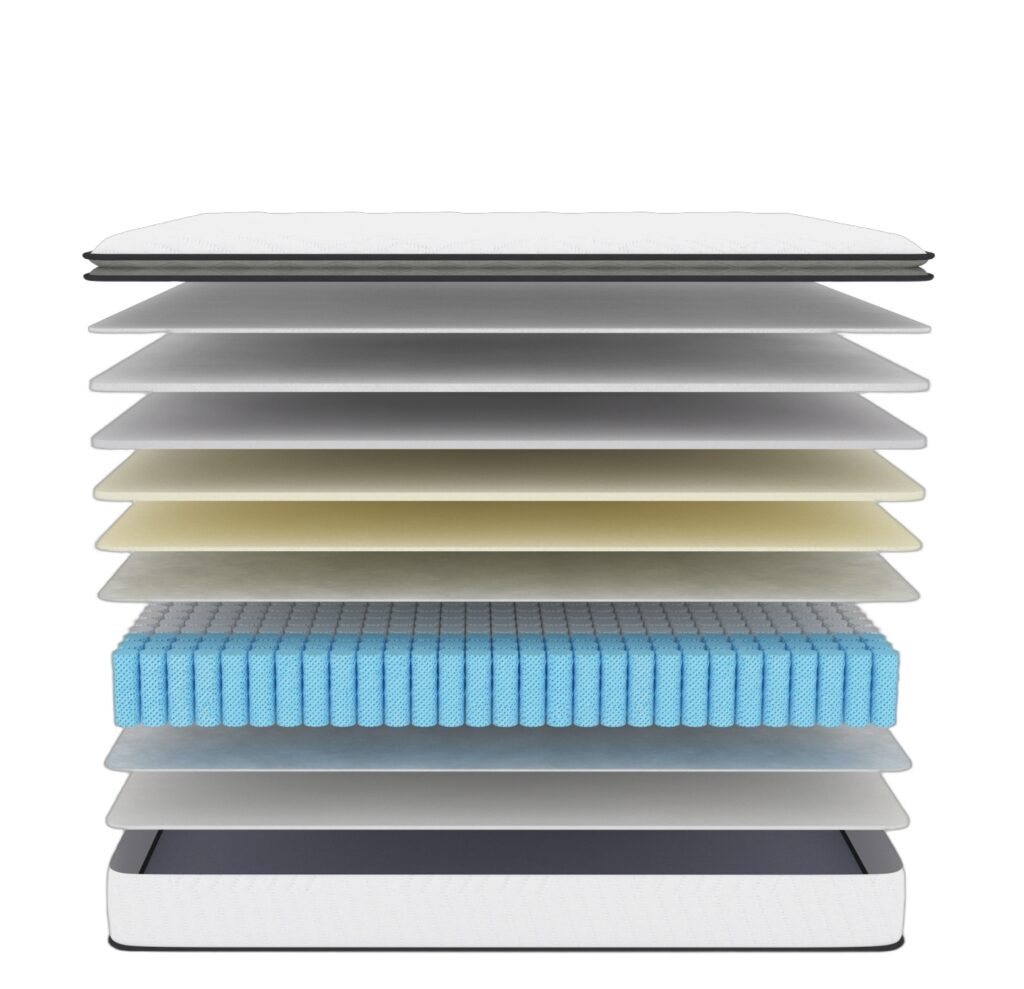
This article explains how cooling construction actually works, what materials matter most, and where cooling claims can fall short. It is written for mattress shoppers who want to compare cooling features against their own real-world sleep habits—without relying on marketing slogans.
How Cool Gel Mattresses Work: The Cooling Construction
Cool gel mattresses are built around the idea of thermal conductivity. Traditional memory foam traps body heat because its dense cell structure restricts airflow and absorbs warmth. Cooling gel is designed to counteract this by conducting heat away from the sleeper more quickly, then releasing it into the surrounding air or spreading it across a larger surface.
The gel itself can appear in several forms:
- Gel-infused foam: Liquid gel or gel beads are mixed into the foam during manufacturing. This increases the foam’s density and thermal mass, drawing heat away from the body.
- Gel-swirl memory foam: Gel is swirled into the foam in visible layers, offering both support and a surface that feels slightly cooler to the touch.
- Gel pods or microcapsules: Encapsulated gel particles are embedded in the foam to create targeted cooling zones.
- Gel layers: A separate gel layer, often perforated, sits atop a support core to directly contact the body.
In all cases, the goal is the same: reduce the rate at which body heat accumulates at the mattress surface. But gel alone is not a magic fix. Its effectiveness depends heavily on the foam density, the amount of gel, and how the mattress integrates airflow and cover materials.
Key Materials That Affect Cooling Performance
A cool gel mattress is only as good as the sum of its materials. Three main material categories influence how cool a mattress actually sleeps:
| Material | Cooling Role | Potential Limitation |
|---|---|---|
| Gel-infused memory foam | Pulls heat from the body; feels cool initially | Can still warm up over hours if not paired with airflow |
| Conventional memory foam | Often used as support layer beneath gel top | Traps heat if too dense or thick |
| Polyfoam (HD or regular) | Transition or base layer | Poor breathability; can act as insulator |
| Latex (natural or synthetic) | Naturally aerated; less heat retention | Rarely found in budget cool gel models |
| Copper/graphite-infused foam | Adds conductivity beyond gel | Often marketed together; true effect is moderate |
| Phase-change materials (PCM) | Absorbs, stores, and releases heat to maintain stable temperature | Works only within narrow temperature range; performance fades over time |
According to Principles and Practice of Sleep Medicine (Chapter 42), the microclimate between the skin and the mattress plays a critical role in thermal comfort, and materials that wick moisture and promote air exchange can significantly improve sleep quality. A mattress that relies solely on gel without these complementary features may still sleep warm.
Airflow and Breathability: What Makes a Difference
Gel can conduct heat, but the mattress must still release that heat somewhere. That’s where airflow and breathability come in.
Manufacturers use several strategies to keep air moving inside the mattress:
- Open-cell foam structures: Foams with more interconnected pores allow air to circulate.
- Perforated or channeled foam layers: Holes or grooves create pathways for heat to escape.
- Pocketed coil support cores: Traditional innerspring systems have natural airflow between coils, which can pull heat away from foam layers above.
- Air-gapped designs: Some hybrid models separate the gel foam from the support core with a small air space to encourage convection.
The bottom line is that gel alone does not prevent heat buildup. If the support core is a dense, unventilated foam block, heat will eventually saturate the gel layer. Hot sleepers should look for a cool gel mattress that actively uses one or more of these airflow features.
Cover Materials: The First Layer of Heat Management
Before body heat even reaches the gel layer, it must pass through the mattress cover. For hot sleepers, the cover can make or break the cooling experience.
Common cooling cover materials include:
- Phase-change material (PCM) covers: These are often marketed as “cool to the touch” because they absorb heat quickly. However, their effect is temporary; once saturated, they need a break to reset.
- Moisture-wicking fabrics (Tencel, certain polyesters): Pull sweat away from the skin to promote evaporative cooling—useful for people who sweat heavily.
- Natural fibers (cotton, bamboo): Breathable but less effective at active cooling; they simply trap less heat than synthetic slabs.
- Knitted covers with mesh panels: Improve air exchange right at the surface.
University of California, Berkeley’s Sleep Research Center notes that bedding microclimate management is one of the most under-discussed factors in sleep quality, especially for people with night sweats. A cool gel mattress topped with a non-breathable waterproof protector may cancel out the gel’s benefit entirely.
Heat Retention Risks: Why Some Cool Gel Mattresses Sleep Warm
Despite the cooling promise, many cool gel mattresses can still trap heat. The most common reasons include:
- Too much memory foam: Even with gel, thick layers of memory foam (above 4 inches) can insulate the body.
- High foam density: Denser foams (above 5 lbs/ft³) retain more heat because the air pockets are smaller.
- Enclosed covers: A non-breathable, quilted cover can act like a plastic sheet, preventing heat from escaping.
- Poor design balance: A thin gel layer over a thick, heat-trapping support core cools only for the first few minutes.
- No airflow pathway: If the mattress lacks internal channels or coils, heat has nowhere to go.
A clinical review in Sleep Medicine Clinics (2019) points out that people with certain medical conditions or higher metabolic rates may perceive cooling mattresses differently, and what feels neutral to one sleeper may feel hot to another. Therefore, cooling performance is not absolute; it is highly personal.
Who Benefits Most from a Cool Gel Mattress?
Not every sleeper needs an actively cooled mattress. A cool gel mattress is most beneficial for:
- People who sleep hot regardless of ambient temperature
- Menopausal women experiencing night sweats
- Sweaty sleepers who wake up with damp sheets
- Those who use memory foam but find they overheat by morning
- Couples where one partner generates more body heat
Conversely, a cool gel mattress offers little extra value for people who sleep cold, use bedroom air conditioning effectively, or prefer plush, sink-in mattress feels that naturally trap more heat. In those cases, a conventional mattress might be a better fit.
Cooling Claims vs. Real Sleep-Use Cases
Marketing terms like “ice fabric,” “arctic gel,” and “zero heat retention” rarely translate to a full night of cool sleep. Here are some common claims and what they typically mean in practice:
| Marketing Claim | Likely Real-World Experience |
|---|---|
| “Cool to the touch” | Cover feels cool for a few minutes, then warms with body contact |
| “Gel-infused memory foam” | Sleeps slightly cooler than old-style memory foam, but still thermally dense |
| “Phase-change cooling cover” | Helps moderate temperature spikes but cannot actively cool all night |
| “Breathable open-cell design” | Most effective claim if combined with airflow layers; otherwise, minimal |
| “Hybrid gel + coils” | Generally the best-performing cooling combination because coils move air |
A 2021 study published in the Journal of Physiological Anthropology found that mattress surface temperature rose steadily over the first two hours of sleep, regardless of gel content, when ambient temperature was above 75°F (24°C). This suggests that cooling materials are most helpful in the early sleep stages, but environmental factors like room temperature often dominate over the course of the night.
What to Look for When Comparing Cool Gel Mattresses
If you decide a cool gel mattress is right for you, focus on these comparison points:
- Gel placement: Top-layer gel is more effective than gel buried deep in the mattress.
- Foam thickness: Look for a cooling layer of at least 1 inch but no more than 3 inches; thicker foam traps heat.
- Support core: Innerspring or latex cores promote airflow better than solid polyfoam.
- Cover breathability: Check if the cover is removable and washable, with a breathable underside.
- Sleep trial and return policy: Cooling is subjective; a trial period allows you to test at home.
- Compatibility with mattress protectors: Avoid waterproof protectors that block air movement unless they are specifically designed for cooling.
Remember, the best cool gel mattress for one person may not be the best for another. Factors such as body weight, sleeping position, room temperature, and personal temperature sensitivity all play a role.
Buyer-Fit Limits: When a Cool Gel Mattress May Not Solve the Problem
Before investing in a cool gel mattress, consider whether your sleeping hot is caused by the mattress or by something else. Bedding, room conditions, and even health factors can override the mattress material’s cooling abilities.
Practical checks:
- Are you using a padded mattress protector that seals in heat?
- Is your bedroom consistently above 70°F at night?
- Do you use synthetic sheets that don’t wick moisture?
- Could your night sweats be related to medications, hormones, or alcohol consumption?
If these factors are present, a cool gel mattress alone may not make a noticeable difference. In such cases, addressing the root cause—changing bedding, lowering room temperature, or consulting a physician—might be more effective than switching mattresses.
Ultimately, a cool gel mattress can reduce heat buildup for many hot sleepers, but it is not a universal fix. The cooling performance depends on how the gel works with the entire mattress construction and the sleeper’s own environment.
References
- [Principles and Practice of Sleep Medicine (Chapter 42) – Thermal environment and sleep]
- [Sleep Medicine Clinics – Review on mattress microclimate and sleep quality, 2019]
- [Journal of Physiological Anthropology – Study on mattress surface temperature and gel content, 2021]
- [University of California, Berkeley – Sleep Research Center guidance on bedding microclimate]
References
Related Guides in This Category
- Cooling Mattress: Cooling Features, Materials and Hot-Sleeper Fit
- Breathable Mattress: Cooling Features, Materials and Hot-Sleeper Fit
- Gel Mattress: Cooling Features, Materials and Hot-Sleeper Fit
- How to Evaluate Best Mattress for Hot Sleepers Without Relying on Generic Rankings
- Mattress Cooling Pad: Cooling Features, Materials and Hot-Sleeper Fit
- Cooling Gel Mattress: Cooling Features, Materials and Hot-Sleeper Fit
- Gel Flex Grid Mattress: Cooling Features, Materials and Hot-Sleeper Fit
- Breathable Crib Mattress: Cooling Features, Materials and Hot-Sleeper Fit
- Gel Foam Mattress: Cooling Features, Materials and Hot-Sleeper Fit
- Cool Mattress: Cooling Features, Materials and Hot-Sleeper Fit